
Cut Your Heating Bills.
Keep Your Home Warm — Without Gas.
Air source heat pumps are the future of home heating — and the government is paying £7,500 towards the cost. We survey, design, install, and handle all the paperwork.
How an Air Source Heat Pump Works
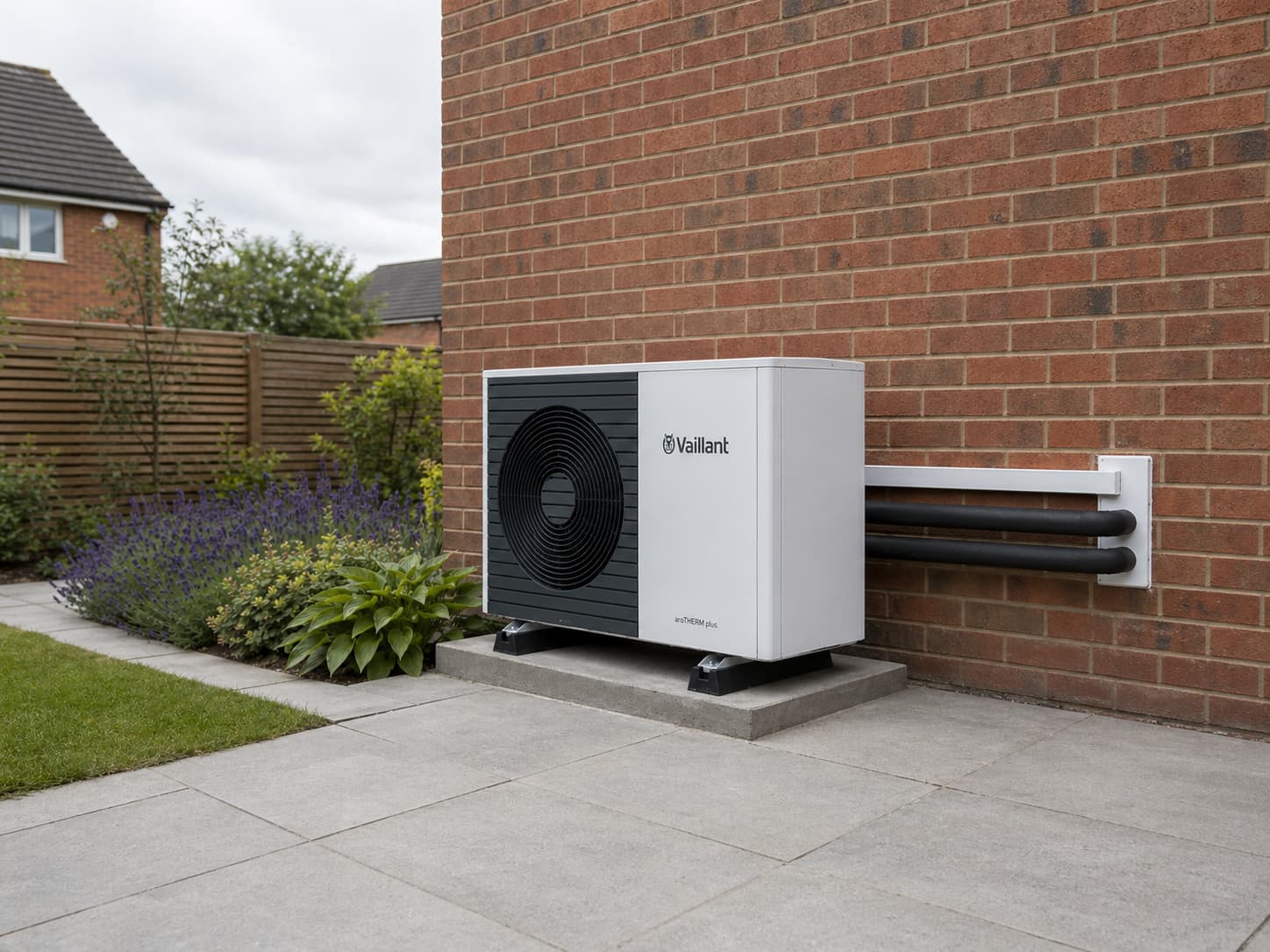
An air source heat pump works like a fridge in reverse. Instead of pumping heat out of a box, it extracts warmth from outdoor air and moves it into your home. Even when it's cold outside — down to −20°C — there's enough heat energy in the air for a heat pump to use.
Extracts heat from outdoor air
A fan draws outdoor air across a refrigerant-filled heat exchanger. Even at low temperatures, the refrigerant absorbs the thermal energy in the air and evaporates.
Compressor raises the temperature
An electrically-powered compressor increases the pressure of the refrigerant, which raises its temperature significantly — high enough to heat your radiators and hot water cylinder.
Heat is transferred to your home
The hot refrigerant passes through another heat exchanger, transferring its energy to your heating circuit — warming your radiators, underfloor heating, and domestic hot water.
Up to 3x more energy efficient
For every 1 unit of electricity it uses, a heat pump delivers 3 or more units of heat — a Coefficient of Performance (COP) of 3+. Because electricity costs more per unit than gas, running cost savings depend on your tariff. On a time-of-use electricity tariff, most homeowners see meaningful savings compared to gas.
£7,500 BUS Grant — What You Need to Know
The Boiler Upgrade Scheme is one of the most generous government energy grants available. Here's exactly how it works and whether you qualify.
BUS Grant Value
Paid directly to your installer. No repayments. No forms for you to fill in.
Estimated ranges only. Your exact price is confirmed after a free home survey. All prices include installation, commissioning, and MCS certification.
How the BUS Grant Works
The Boiler Upgrade Scheme pays £7,500 directly to your MCS-certified installer, reducing your upfront cost. You don't apply for it — we handle the entire application on your behalf. You simply book your installation and the grant is automatically deducted from your invoice.
Eligibility Checklist
- You own the property (rented out or owner-occupied)
- A valid EPC for the property (issued within the last 10 years)
- Replacing an existing fossil fuel heating system (gas, oil, or LPG)
- Using an MCS-certified installer — that's us
Don't have an EPC, or yours has expired? Don't worry — we check this as part of your free survey and can help you arrange a new assessment if needed.
Benefits of a Heat Pump
Heat pumps aren't just greener — they're smarter. Here's why thousands of UK homeowners are switching.
Lower Running Costs
With a COP of 3 or higher, heat pumps deliver 3 units of heat for every 1 unit of electricity. Paired with a time-of-use electricity tariff — which we help you set up — most homeowners pay less than they did with gas, and that gap is expected to widen as electricity gets cleaner and costs fall.
£7,500 Government Grant
The Boiler Upgrade Scheme dramatically reduces the upfront cost of a heat pump. Most eligible homeowners pay between £500 and £6,500 after the grant — making a heat pump a genuinely affordable option today.
No Gas Required — Future-Proof
Heat pumps run entirely on electricity, which means no gas bills and no exposure to volatile gas prices. As the UK grid gets cleaner, your heating automatically gets greener too — no further changes needed.
Very Low Maintenance
Unlike a gas boiler, a heat pump doesn't require an annual Gas Safe service. Most manufacturers recommend a simple check every 2–3 years. There's no combustion, no pilot light, and no flue to worry about.
15–20 Year Lifespan
A well-installed and maintained heat pump will typically last 15–20 years — significantly longer than the 10–12 year average lifespan of a gas boiler. That's a long runway over which to recoup your investment and enjoy lower running costs.
Works with Underfloor Heating & Upgraded Radiators
Heat pumps work best at lower flow temperatures, which suits underfloor heating perfectly. Existing radiators can often be upgraded or upsized to work efficiently — we assess this as part of your free survey.
Estimate Your Price by Property Size
Heat pump cost depends on property size, insulation, and your current heating setup. The ranges below cover most homes — we confirm your exact price after a free 20-minute home survey.
Prices include installation, commissioning, MCS certification, and 0% VAT (Energy Saving Materials relief, in force until at least 31 March 2027). Final price confirmed after free home survey. Hard-to-reach installations, radiator or cylinder upgrades, or poorly insulated homes may push the total above these ranges.
Heat Pump FAQs
We know heat pumps raise a lot of questions. Here are honest answers.
To qualify for the Boiler Upgrade Scheme you need to own the property (including landlords and second homeowners), have a valid EPC (issued within the last 10 years), be replacing a fossil fuel heating system (gas, oil, or LPG), and use an MCS-certified installer. The scheme runs until 2030 and there's no household income threshold — most homeowners qualify. We check eligibility as part of your free survey so you'll know before committing to anything. Visit our grants page for a full eligibility checker.
Modern heat pumps are much quieter than older models. A typical unit produces around 40–50 decibels at one metre — similar to a refrigerator or a quiet conversation. They're significantly quieter than most air conditioning units. Placement matters: we position units away from bedroom windows and boundaries, and most permitted development rules require units to be at least 1m from a property boundary. We'll discuss positioning carefully during your survey.
In many homes, yes — though some radiators may need to be upsized. Heat pumps work at lower flow temperatures than gas boilers (typically 45–55°C instead of 65–80°C), which means radiators need more surface area to deliver the same heat output. During your survey we use heat loss calculations to check each room and identify any radiators that need replacing. In well-insulated homes, existing radiators often work well without changes.
A standard heat pump installation typically takes 2–4 days, depending on the complexity of your existing heating system, whether radiator upgrades are needed, and the size of your property. We'll give you a precise estimate after your survey. Our installers are tidy, considerate, and will make sure your heating is fully functional before they leave each day. Most customers are pleasantly surprised at how smooth the process is.
You need a valid EPC (issued within the last 10 years) to access the BUS grant, but there is no minimum EPC rating — even homes rated E, F, or G can qualify. If you don't have one, or yours has expired, we can help you arrange a new assessment. While a well-insulated home will get better performance from a heat pump, insulation upgrades are not a requirement for the grant.
Heat pumps do become slightly less efficient as outdoor temperatures drop — a unit with a COP of 3.5 in autumn might operate at 2.5–3.0 during a cold snap. However, they're designed to work in temperatures as low as −20°C, and UK winters rarely get below −5 to −10°C in most areas. Even at reduced efficiency, heat pumps still outperform a gas boiler, which has a maximum efficiency of around 90%. A well-designed system maintains comfortable indoor temperatures throughout a typical UK winter.